
Accommodations
Things to Do
Tadiandamol, Coorg
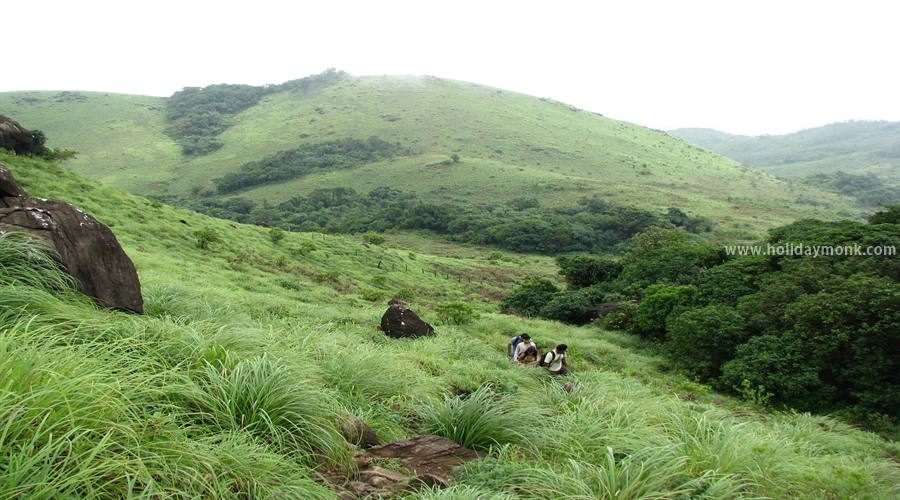
At a height 1800 m, Tadiandamol is the second highest peak in Karnataka next to Mullayanagiri hills (1930 m) in Chikmagalur. The peak belongs to the group of taller peaks between Himalayas in the north and Nilgiris in the South. Tadiyendamol is a part of the range of Western Ghats that lie in Coorg District of Karnataka. This range experiences a salubrious climate throughout the year. Elephants, bison, tigers, wild cats, and variety of birds habitat the thick vegetation. Plenty of waterfalls and natural springs adorn the valleys. The flora & fauna of Coorg add to the beauty of the valley. Most of the land with natural vegetation around the peak is taken over by Plantation growers and converted to Plantations of coffee, pepper, cardamom, beetle leaves, and areca nut. The forest department well maintains the forest range with early burning of weeds and shrubs, planting trees to re-grow the forest and maintenance of trees.
A famous trekking spot in Coorg, trekking at Thandiyendamol will rejuvenate both your body and mind.
How to Reach Tadiandamol
It is situated near Virajpet, about a 30kms away, on the way to Napoklu, Bhagamandala. This peak is just adjacent to the Makutta forest. On the way, you also get an old palace called ‘Nalku Naadu Aramane’. To reach Tadiyendamol peak, you have to get down at the Aramane stop which is before a place called Kakkabbe (if you are coming from Virajpet). From that place the peak is around 6 km away. There is a road which will take you to the top if the peak. There is a stream at the foothill of the peak, which is good for camping. There is a path just adjacent to the path which takes you to the peak.
MORE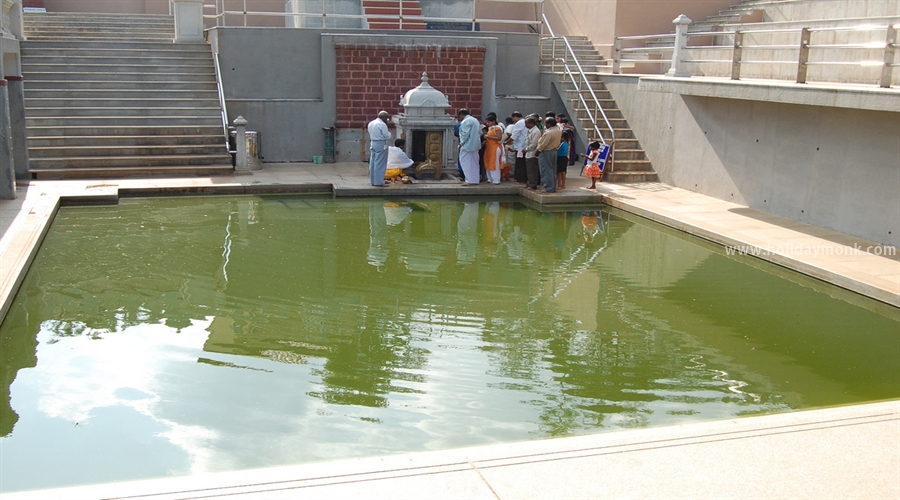
Talakaveri
Talakaveri is the place that is generally considered to be the source of the river Kaveri. It is located by Brahmagiri hill (not to be confused with the Brahmagiri range further south) near Bhagamandala in Kodagu district, Karnataka, 1,276 m. above sea level. However, there is not a permanent visible flow from this place to the main rivercourse except during the rainy season.
A tank or kundike has been erected on a hillside, at the place that is said to be the origin. It is also marked by a small temple, and the area is frequented by pilgrims. The river originates as a spring feeding this tank, which is considered to be a holy place to bathe on special days. The waters are then said to flow underground to emerge as the Kaveri river some distance away. The temple has been renovated extensively by the state government recently [2007].
On Tulasankramana day (the first day of Tula Masa month, according to the Hindu calendar, which normally falls in mid October) thousands of pilgrims flock to the river’s birthplace to witness the rise of the fountainhead, when water gushes up from the spring at a predetermined moment. The tula snanam (Sacred bath in the Tula month) is observed across pilgrim towns in Kaveri’s banks.
Talakaveri is about 8 km away from Bhagamandala and 48 km from Madikeri.
This temple, considered to be one of the holiest places in Coorg, is believed to be the origin of River Kaveri.
Pilgrim Center
The temple here is dedicated to Goddess Kaveriamma. Other deities worshipped here are Lord Agasthiswara, which denotes the link between Kaveri and Sage Agasthya and Maha Ganapathi.
The legend goes that the Kaveri river was held in a Kamandalu (a container of sacred water) by Sage Agastya. Vinaayaka (Lord Ganesha) took the form of a crow and perched on the kamandalu of Agasthya when Agasthya was meditating. When Agastya realised this, he shooed away the crow. But the devine crow tipped the kamandalu and toppled it. Out poured Kaveri which started flowing. The crow disappeared and in its place stood a small boy. Agasthya thought that the boy was playing some prank and clenching both his fists, went to pound the head of the small boy. But the boy escaped and Agasthya gave chase. Finally the boy vanished and Lord Ganesha showed himself to Agasthya. Agasthya was aghast at the realisation that he had just tried to knock the head of Lord Ganesha himself. As atonement, he knocked his own head with both of his clenched fists.
The link between Kaveri and Lord Ganesha also extends to Srirangam as well, in Lord Ganesha’s role in setting up the Ranganatha temple there. The temple at Tirumakudalu Narasipura (confluence of Kabini, Kaveri and the legendary Spatika Sarovara)) is also dedicated to Agasthiwara.
History of the temple priests of Talakaveri
It is believed that Mayura Varma, and Narasimman the Kadamba King who ruled vast areas of southern and central India in the 4th Century A.D. brought Brahmins from Ahi Kshetra (or Ahichatra) and put them in-charge of various temples in Tulu Nadu. Ahi Kshetra is mentioned in the Mahabharata as lying north of the Ganges, and as being the capital of Northern Panchala. It is apparently the Adisadra of Ptolemy, and its remains are visible near Ramnagar in Tahsil Aonla in Bareilly district.
The Brahmins who first landed in Shivalli in Tulunadu and then spread across 31 villages came to be known as Shivalli Brahmins or Tulu Brahmins. It is from Shivalli and Tulu Brahmins, that the priests of Talakaveri temple have come from.
Achar Family of Talacauvery
The beginning of the Achar family in Talakaveri starts ten generations or about 220 to 230 years ago. A Brahmin named Venkappayya and his two brothers, along with their families came to Talakaveri on a pilgrimage. Lingaraja the First was the ruler of Kodagu. One night God appeared in Lingaraja’s dream and indicated that there was a Brahmin family currently visiting Talakaveri. God commanded Lingaraja to appoint this Brahmin to be the priest at the temple. After the king arose from his dream, he sent for this Brahmin family. The king’s messengers found Venkappayya in Talakaveri and informed him about the king’s desire. Venkappayya accompanied the king’s messengers from Talakaveri to Madikeri, a distance of about 24 miles to meet the king.
Lingaraja received Venkappayya and requested him to start daily puja at the temple. The king set up an endowment to pay Venkappayya for his services at the temple. This was the beginning of the Achar family of Talacauvery. The priesthood bestowed by Lingaraja upon Venkappayya has passed on through many generations to his heirs. It is hereditary as most priesthoods are, and all male members of the family have the birthright to become priests at the temple. The current generation of Achar priests at the temple is the ninth from Venkappayya.
Venkappayya came from Shivalli Halli (village) of South Canara district. The Brahmins here were called Putturayas, probably meaning priests from Puttur. This Puttur is near Udupi. Venkappayya Putturaya’s descendants are the Achars. The current Achars are the ninth generation from Venkappayya. It is not known why the descendants of Venkappayya took on the surname of Achar. Although Venkappayya came to Talakaveri with his two brothers, only Venkappayya’s descendants are documented.
Nearby
The Brahmagiri hill is situated right beside the temple. There are a series of steps leading to the top of the hill. From there, one can have a 360 degree view of the surrounding hills.
MORE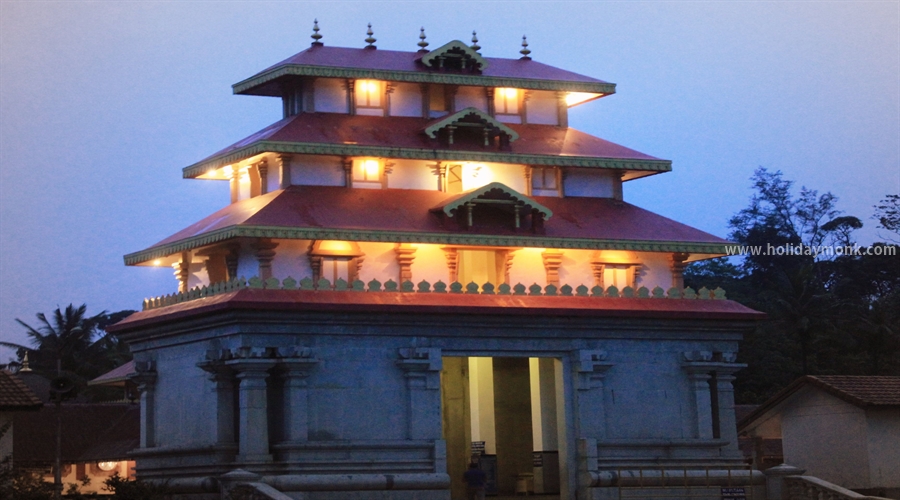
Bhagamandala
Bhagamandala is a pilgrimage place in Kodagu district of South Indian state of Karnataka. It is situated on the river Kaveri in its upstream stretches. At this place, the Kaveri is joined by two tributaries, the Kannike and the mythical Sujyoti river. It is considered sacred as a river confluence (kudala or triveni sangama, in Kannada and Sanskrit respectively). Similarly the other related place is Udhaka mandala(English name: Ooty) which means land beside water body in Kannada and Sanskrit respectively.
It is a common practice for pilgrims to take a dip in the triveni sangama and perform rituals to their ancestors before proceeding to Talakaveri, the birthplace of Kaveri. During Tula Sankramana which falls on October 17 or 18th, pilgrims assemble here in large numbers.
Triveni sangama near Bhagmandala Temple
A short distance from the triveni sangama, there is a famous temple known as Sri Bhagandeshwara temple, where Bhagandeshwara (Ishwara), Subramanya, Mahavishnu and Ganapati idols are installed. This place is also known as Bhagandeshwara Kshetra, from which the name Bhagamandala is derived. The temples in this area are built in Karavali(West Coast) style.
During 1785–1790, the area was occupied by Tipu Sultan. He renamed Bhagamandala to Afesalabad. In 1790 King Dodda Vira Rajendra took Bhagamandala back into an independent Kodagu kingdom.
Bhagamandala is located about 33 km from the district headquarters Madikeri and is connected by paved roads from Madikeri, Virajpet and nearby places in Karnataka and Kerala. Government and private buses are available on all of these routes.
A short distance from Bhagamandala is the temple at Padi, which houses the deity Lord Igguthapp and is considered by many Kodavas to be the most sacred shrine in their homeland.
One more temple at Aiyangeri by name “CHINNATHAPPA”,which houses the deity Lord Sri Krishna,considered by the people of the village to be the most sacred shrine in their home land. There is a festival once a year in the month of February or March, where the “Golden Flute” will be brought out from the temple.
Mt.Thavoor is a towering peak overlooking Bhagamandala,and Mt.Koppatti, which may be considered its twin peak is nearby and both these serve as fantastic trekking routes for anyone wishing to savour the mesmerising beauty of the Shola forest range.
MORE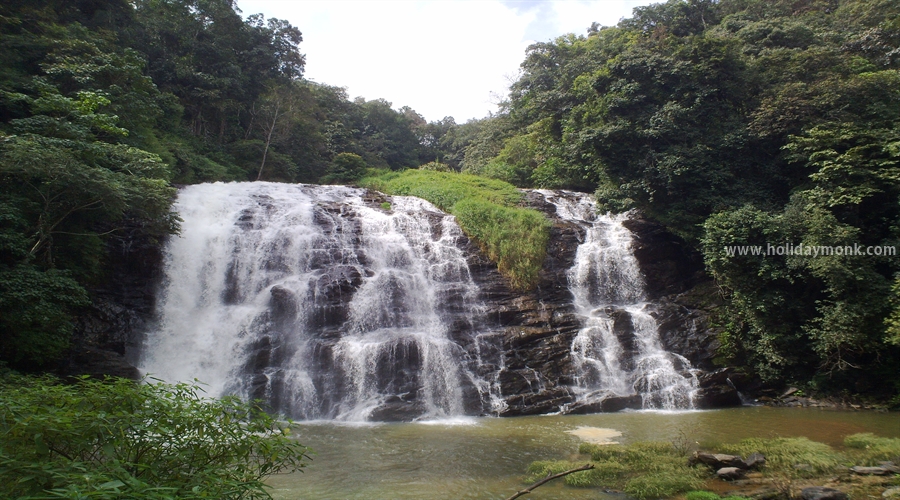
Abbey Falls
Abbey Falls (also spelled Abbi Falls and Abbe Falls) is in Kodagu, in the Western Ghats in Karnataka. It is located 8 km from the Madikeri, 268 km from Bangalore and 122 km from Mysore. One of the most popular tourist spots in Coorg, Abbey Falls, Karnataka is located 7 km from Madikeri. The River Kaveri makes a descent here from a height of about 21 meter from sea level, providing a splendid sight. The cascading crystal clear water in the midst of the emerald flora that surround the fall, is something you will see only in Coorg. The fall is a perfect picnic spot with unexplored walking trails around the area. Recently, a hanging bridge has been laid across the gorge adding to the beauty of the place. The explorer in you will be really delighted to know about the unexplored and untrodden area around the falls. To reach the falls, one has to take a 500 m downhill walk from the end of the road. The area around this fall is rich with coffee bushes and wild vines and creepers. The best time to visit Abbey Falls is during the monsoons.
Abbey Falls is one of the most popular tourist destinations in Coorg.
The waterfalls
The river is part of the early reaches of the river Kaveri. Flow is much higher during the monsoon season.
The waterfall is located between private coffee plantations with stocky coffee bushes and spice estates with trees entwined with pepper vines. A hanging bridge constructed just opposite the falls. There is a Kali Mata temple on one side of the bridge.
From Madikeri the falls are accessible by a narrow road to the coffee estate. A path through coffee and cardamom plantations leads to the waterfalls. The roar of the falls can be heard from the road.
Quick Facts
The British called the Abbey Falls as ‘Jessie Waterfalls’ in memory of Jessie, the daughter of Madikeri’s first British captain.
Best Season to visit Abbey Waterfalls
June to December
The Mysore – Mangalore high way passes through Madikeri. Bangalore(260 km) and Mangalore (136 km), Mysore 120 Kms, Kannur 120Kms.
MORE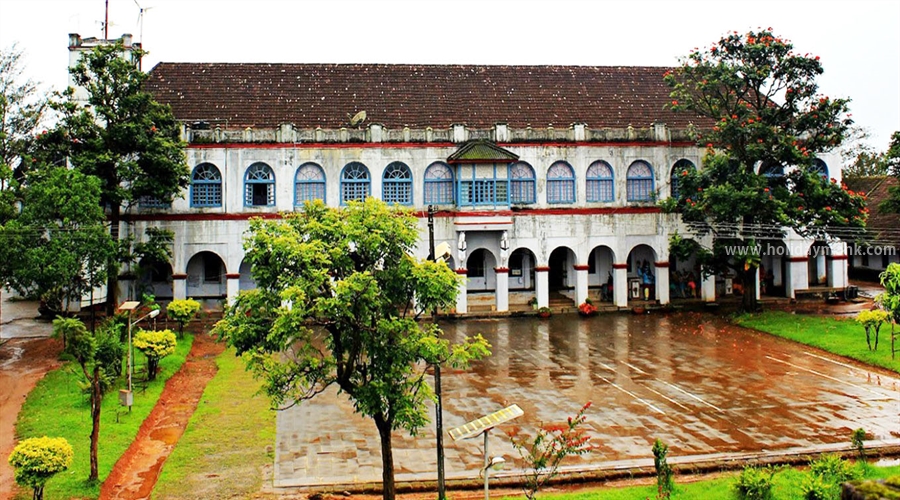
Madikeri Fort
Madikeri Fort (Coorg District) was first founded by Mudduraja in the second half of the 17th century. He also built a palace inside the fort. It was eventually rebuilt in granite by Tipu Sultan who named the site as Jaffarabad. In 1790, Doddavira Rajendra took control of the fort. The British who added to the fort in 1834. The palace was renovated by Lingarajendra Wodeyar II in 1812-1814. In the north-east corner at the entrance are two life size masonry elephants and a church is present in the south-east corner.
Madikeri Deputy Commissioner’s Office is located inside the Madikeri Fort premises. The church building houses a museum, which contains several items related to history – mainly the British rule era, and also has a huge portrait of Kodagu’s eminent personality Field Marshal K. M. Cariappa.
MORE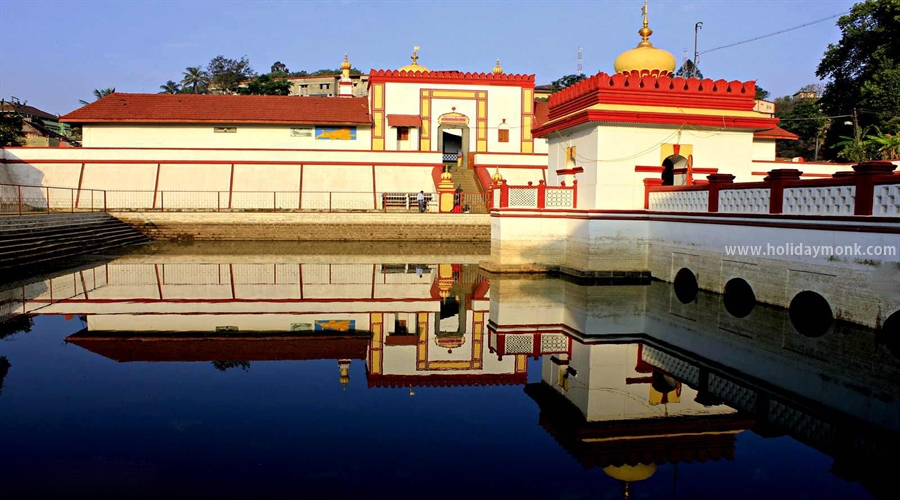
Omkareshwara Temple Madikeri
The Omkareshwara Temple is an ancient shrine dedicated to Lord Shiva. It is situated in the town of Madikeri in Coorg, Karnataka. The specialty of the temple is that its construction reflects a mix of Gothic and Islamic styles. It is a popular religious destination of Coorg. The temple draws a large number of tourists and devotees regularly.
Quick Facts About Omkareshwara Temple
Timings: 6:30 AM to 12:00 Noon; 5:00 PM to 8:00 PM
Best time to visit: between the months of October to March
Entry Fee: Free
Duration of Visit: 1 hour (approximately)
Temple Info
Abhisheka – 6:30 AM to 6:45 AM
Ganga Pooja – 7:00 AM
Maha Pooja – 12:00 noon
Maha Pooja – 8:00 PM
Every Full moon day – Mass Sathyanarayana Pooja
Every 1st Tuesday of the month – Mass Ganahoma at Kote Ganapathi temple
History of Omkareshwara Temple, Coorg
The Omkareshwara temple in Madikeri was built by Lingarajendra II in 1820 in the Mumammadan style of architecture with a dome in the center and four turrets at four corners. Temple dedicated to Shiva, was built in the 19th century in a mix of Gothic and Islamic styles. Legend has it that the King put to death a Brahmin to fulfill his political ambitions and in order to appease the spirit of the Brahmin, the temple was built.
That Brahmin became a “Brahmarakshasa” and started teasing the king with troubles. It left the king only when the king brought a “Shivalinga” from Kashi and installed it after building a temple. The shivalinga was named as “Omkareshwara” and regular rituals were performed. The bars of the windows of the temple were made of “Panchaloha” and an alphabet “lim” has been placed in between the bars
Overview
There is a pool in front of the temple with tons of fresh water fishes in it. The temple has four minarets around it and a dome in the center. The temple is Similar to a Muslim dargah with a Linga installed near the entrance door. The King inscribed the history of the temple in a copper plate which is fixed at the entrance door frame. There is a water tank in front of the temple and in the middle of the tank there is a “mantapam” connected by a causeway. There are plenty of fish in the tank which is an attraction for children.
This spot is inside Madikeri Town, just a minimal fare in auto.
MORE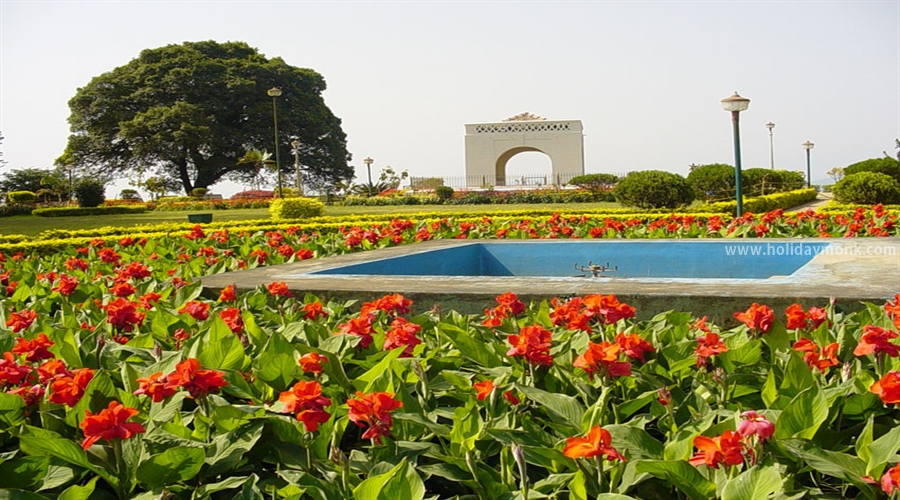
Raja’s Seat
Raja’s Seat (Seat of the King) is a seasonal garden of flowers and artificial fountains. It is one of the most important tourist spots in madikeri of Coorg District. It is 270 km away from Bangalore, the capital of Karnataka.
A pleasant spectacle of refreshing layers of greenery, chain of high and low-rise-mountains attired with mist, the Raja Garden is one-time-favorites of Kings of Kodagu who used to watch the setting sun, and spend time with their queens here. The structure is small square in brick and mortar of four pillars bridged by arches, enhanced by beautiful surroundings. This lovely spot was a favorite place of recreation for the Rajas and hence was permanently associated with them. It is built on a high level ground with a commanding view of the cliffs and valleys to the west. Early in the morning as the sun is just rising in the east, the mist shrouded valley below offers a rare sight. The golden light of the setting sun is a splendor to watch. There is also an attraction of the Toy Train for children.
MORE